Εμφάνιση αναρτήσεων με ετικέτα VATICAN. Εμφάνιση όλων των αναρτήσεων

Τρίτη 6 Αυγούστου 2013

VATICAN 2013 - XXVIIIth World Youth Day in Rio de Janeiro


XXVIIIth World Youth Day in Rio de Janeiro - 2013

From 23 to 28 July in Rio de Janeiro the 28th World Youth Day will be celebrated. On this occasion the Christ the Redeemer statue will not only recall the most well-known and loved symbol of the Brazilian city, but also the global meeting place of more than two million young people expected to attend. The message released the 18 October 2012 by Benedict XVI says “Christ’s open arms are a sign of his willingness to embrace all those who come to him”.
  The theme chosen for the event is “Go and make disciples of all nations!” (cf. Mt 28:19), an exhortation to young people to evangelize, so that, as Blessed John Paul II noted, “faith is strengthened when it is given to others”. Newly elected Pope Francis will be there to welcome the young people from around the world, to pray with them, to exchange views and to adore the Lord Jesus with them. The Church always has need of the energy, strength, vitality and ideas of young people. The renewal of the Church’s universal mission has to involve and come through them. The celebration of World Youth Day in a country where the majority of the population is young marks a special occasion to strengthen this important bond and unite in a common mission. 


VATICAN 2013 - JOINT ISSUE WITH ITALY - 1700TH ANNIVERSARY OF THE EDICT OF MILAN

JOINT ISSUE WITH ITALY - 1700TH ANNIVERSARY OF THE EDICT OF MILAN

The Edict of Milan established freedom of worship and marked an end to religious persecution by recognizing the right to profess one’s own faith. The declaration was issued in 313 AD in Milan, where Costantia, daughter of Constantine (emperor of the west) married Licinius (emperor of the east). From the beginning, the Christians would not participate in the imperial cult which claimed the divine status of the Roman emperors. For this reason, the Christians were opposed by the political and religious authorities. The Christian martyrs, the faithful who gave their lives for the faith, are eternal witnesses to the ferociousness of this persecution. In modern times, the “Universal Declaration of Human Rights” (UN, 1945) and the “Declaration Dignitatis humanae” (Second Vatican Council, 1965), have solemnly established the right to religious freedom. Despite these developments religious persecution has become again, even in recent times, a serious global problem. Since the theme of religious freedom is still current, celebrations to mark the 1700th anniversary of the “Edict of Milan” can offer a moment for reflection and help create awareness on how profession of religious faith can be an expression of adherence to truth, only if “voluntary and personal”, since external coercion represents the antithesis of the divine message. The philatelic issue for this occasion consists of a series of three postal values and a mini sheet, the latest in a joint issue with Italy, depicting scenes of Constantine and Pope Sylvester I taken from the recently restored 13th century frescoes in the Oratory of Saint Sylvester at the Santi Quattro Coronati Basilica in Rome.

VATICAN 2013 - 1150th ANNIVERSARY OF THE EVANGELIZATION OF GREAT MORAVIA BY SAINTS CYRIL AND METHODIUS


1150th ANNIVERSARY OF THE EVANGELIZATION OF GREAT MORAVIA BY SAINTS CYRIL AND METHODIUS

This year marks the 1150th anniversary of the evangelization of Great Moravia by Saints Cyril and Methodius. Great Moravia included a large part of Central Europe, going well beyond the borders of current States. The territory experienced a period of great cultural and religious development between the 9th and 10th centuries.The few pieces of information regarding the two brothers, Cyril and Methodius, come from writings on them by the Bishop Gauderico of Velletri (865 p.C.), who was grateful to Cyril for having assisted in transferring the remains of Pope St. Clement I to Rome. Born into a Greek noble family in Thessaloniki, the brothers studied in Constantinople and were soon sent by the emperor on various diplomatic missions to the East. When the king of Great Moravia asked the emperor of Byzantium to send missionaries to his land, the emperor chose Cyril and Methodius. Cyril, who had the widest range of knowledge, translated the Bible for the Slavic peoples and even created a new alphabet, the Glagolitic script. Later, however, disagreements with the German clergy claiming dominion over the territory led the Pope to call the two missionaries to Rome. Cyril served there for some time before becoming sick and dying in 869. He is buried in the Basilica of San Clemente. Methodius was ordained a Bishop and returned to Moravia where the new king, who favored the German presence, persecuted his disciples. Methodius was imprisoned for two years and died in Velehard in April 885. The work of Saints Cyril and Methodius, proclaimed patrons of Europe in 1980 by Pope John Paul II, is of fundamental importance from a historical and spiritual perspective. The legacy includes the Glagolitic alphabet developed into Cyrillic, which brought the Slavic peoples closer to Greco-Byzantine culture and Christianity, while also creating the basis for a sense of nationhood, until then unknown.

Τετάρτη 19 Δεκεμβρίου 2012

VATICAN 1968 - Journey of Paul VI in Bogotá

Viaggio di Paolo VI a Bogotà


25L                                Paolo VI
55L                                Ostensorio - monstrance
220L                              Carta dell'America meridionale - Charter of South America

VATICAN 1968 - Archangel Gabriel

Arcangelo Gabriele


1000L                         Arcangelo Gabriele
1500L                         Arcangelo Gabriele


The name Gabriel means "man of God," or "God has shown himself mighty." It appears first in the prophesies of Daniel in the Old Testament. The angel announced to Daniel theprophecy of the seventy weeks. His name also occurs in the apocryphal book of Henoch. He was the angel who appeared to Zachariah to announce the birth of St. John the Baptizer. Finally, he announced to Mary that she would bear a Son Who would be conceived of the Holy Spirit, Son of the Most High, and Saviour of the world. The feast day is September 29th. St. Gabriel is the patron of communications workers.

VATICAN 1967 - CHRISTMAS

Natale


VATICAN 1967 - World Congress for the Lay Apostolate

Congresso mondiale per l'apostolato dei laici


40L                    Emblema del congresso - Emblem of Congress
130L                  Emblema del congresso - Emblem of Congress


VATICAN 1967 - 50th anniversary of the apparitions of Fatima

50º anniversario delle apparizioni di Fatima


30L                       I tre pastorelli - The three shepherds
50L                       Santuario di Fatima - Sanctuary of Fatima
200L                     Paolo VI a Fatima - Paul VI at Fatima

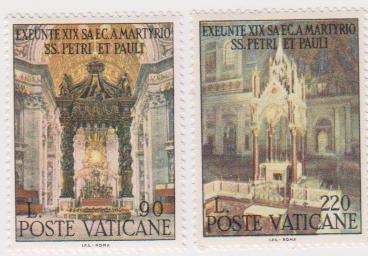
VATICAN 1967 - 19th centenary of the martyrdom of Saints Peter and Paul

19º centenario del martirio dei Santi Pietro e Paolo


15L                              San Pietro - St. Peter
20L                              San Paolo - St. Paul
55L                              Vetro dorato - golden glass
90L                              Altare in San Pietro - Altar in St. Peter's
220L                            Tabernacolo in San Pietro - Tabernacle in St. Peter's


VATICAN 1967 - AIRMAIL

Soggetti vari


20L                         Aereo e basilica di San Pietro - Air and St. Peter's Basilica
40L                         Antenna e statua dell'arcangelo Gabriele - Antenna and a statue of the Archangel Gabriel
90L                         Basilica di San Pietro -  St. Peter's Basilica    
100L                       Aereo e basilica di San Pietro - Air and St. Peter's Basilica
200L                       Antenna e statua dell'arcangelo Gabriele - Antenna and a statue of the Archangel Gabriel
500L                       Basilica di San Pietro - St. Peter's Basilica

St Peter's Basilica in the Vatican City is an iconic and popular landmark of Rome. Regarded as one of the most holiest sites in the Christian world, many make a pilgrimage to the cathedral every year to celebrate Mass with the Pope.
Building work for this grand structure originally began in 1506 and is the burial site of it's namesake Saint Peter, one of the 12 apostles of Jesus. One of the key architects of the Basilica was Michelangelo and some of his original drawings for a section of the Dome were found as recently as 2007.


Κυριακή 16 Δεκεμβρίου 2012

VATICAN 1966 - Closing the ecumenical council

Chiusura del concilio ecumenico


10L                       Giovanni XXIII
15L                       Vangelo
55L                       Messa solenne                                  
90L                       Paolo VI e Atenagora
100L                     Anello episcopale
130L                     Paolo VI

VATICAN 1966 - Millennial Catholic Poland

Millenario cattolico della Polonia


15L                        Mieszko I e la regina - Mieszko I and Queen
25L                        S.Adalberto
40L                        S.Stanislao
50L                        Regina Edwige - Queen Edwige
150L                      Madonna di Polonia
220L                      Paolo VI in Polonia

Κυριακή 9 Δεκεμβρίου 2012

VATICAN 1966 - The work of man

Il lavoro dell'uomo


5L                              Paolo VI - Paul VI
10L                            Musica - Music
15L                            Scienze - Sciences
20L                            Pittura - Painting
30L                            Scultura - Sculpture
40L                            Arte edile - Art building
55L                            Arte del legno - Woodworking
75L                            Agricoltura - Agriculture
90L                            Arte del ferro - Iron Art
130L                          Studio - Study
150L                          Stemma di Paolo VI - Coat of arms of Paul VI
180L                          Paolo VI - Paul VI


VATICAN 1965 - 7th centenary of the birth of Dante Alighieri

7º centenario della nascita di Dante Alighieri


10L                        Dante Alighieri
40L                        L'inferno - hell
70L                        Il purgatorio - purgatory
200L                      Il paradiso - heaven


Dante Alighieri (1265-1321), Italian poet wrote La Divina Commedia (The Divine Comedy), his allegory of life and God as revealed to a pilgrim, written in terza rima;Inferno (Hell), Purgatorio (Purgatory), and Paradiso (Paradise), written between 1307 and 1321.
The dates of when Dante’s works were written are inexact and many are unfinished, although there is no doubt that Dante is known as the source of modern Italian. Dante has affected a profound influence on numerous poets, playwrights, and authors right into the 21st century.

Although his exact birth date is not known, Dante Alighieri was born in Florence, Italy in the year 1265. His mother Donna Gabriella degli Abati died when he was very young. His father was Alighiero di Bellincione Alighieri, a notary from a family loyal to the Guelphs. The Guelphs supported the Papacy, while the other predominant family of the neighboring area in Tuscany, the Ghibellines, supported the German emperor, thus spurring many power struggles between the two.
It is said that Dante fought with the Guelphs as a cavalryman in the battle of Campaldino (1289), referred to in Purgatorio, which led to the defeat of the Ghibellines. The constitution of the Republic of Florence was reformed and around 1295 it was necessary for Dante to matriculate into the Guild of Physicians and Apothecaries in order to be active in government affairs as diplomat and magistrate. However by 1300 the Guelphs were themselves bitterly divided into two factions, Bianchi and Neri, the Black Guelphs and the White Guelphs. When the Black Guelphs seized power in Florence, all White Guelphs were banished in 1302, including Dante, with the threat of being burned alive if he ever returned.

Σάββατο 8 Δεκεμβρίου 2012

VATICAN 1965 - St. Benedict, patron of Europe

San Benedetto, patrono d'Europa


40L                 San Benedetto - St. Benedict
300L               Monastero di Montecassino - Monastery of Montecassino

Benedict of Nursia  (c.480–547) is a Christian saint, honored by the Anglican Church and the Roman Catholic Church as the patron saint of Europe and students.
Benedict founded twelve communities for monks at Subiaco, Italy (about 40 miles (64 km) to the east of Rome), before moving to Monte Cassino in the mountains of southern Italy. There is no evidence that he intended to found a Roman Catholic religious order.[citation needed] The Roman Catholic Order of St Benedict and the Anglican Order of St Benedict are of later origin and, moreover, not an "order" as commonly understood but merely a confederation of autonomous congregations.
Benedict's main achievement is his "Rule of Saint Benedict", containing precepts for his monks. It is heavily influenced by the writings of John Cassian, and shows strong affinity with the Rule of the Master. But it also has a unique spirit of balance, moderation and reasonableness, and this persuaded most religious communities founded throughout the Middle Ages to adopt it. As a result, his Rule became one of the most influential religious rules in Western Christendom. For this reason, Benedict is often called the founder of western monasticism.


Monte Cassino is a rocky hill about 130 kilometres southeast of RomeItaly, c. 2 kilometres to the west of the town of Cassino  and 520 m altitude. St. Benedict of Nursia established his first monastery, the source of the Benedictine Order, here around 529. It was the site of Battle of Monte Cassino in 1944. The site has been visited many times by the Popes and other senior clergy, including a visit by Pope Benedict XVI in May 2009. The monastery is one of the few remaining territorial abbeys within the Catholic Church.

VATICAN 1965 - Paul VI's visit to UN headquarters

Visita di Paolo VI alla sede dell'ONU


20L                        Paolo VI - Paul VI
30L                        Palazzo dell'O.N.U. - Building Ordinance. N.U.
150L                      Palazzo dell'O.N.U. - Building Ordinance. N.U.
300L                      Paolo VI - Paul VI

POPE PAUL VI
1963-1978


Giovanni Battista Enrico Antonio Maria Montini was born on September 26, 1897 at Concesio (Lombardy) of a wealthy family of the upper class. His father was a non-practicing lawyer turned editor and a courageous promoter of social action. Giovanni was a frail but intelligent child who received his early education from the Jesuits near his home in Brescia. Even after entering the seminary (1916) he was allowed to live at home because of his health. After his ordination in 1920 he was sent to Rome to study at the Gregorian University and the University of Rome, but in 1922 he transferred to the Accademia dei Nobili Ecclesiastici to study diplomacy continuing his canon law studies at the Gregorian. In 1923 he was sent to Warsaw as attache of the nunciature but was recalled to Rome (1924), because of the effect of the severe Polish winters on his health, and assigned to the office of the Secretariat of State where he remained for the next thirty years. Besides teaching at the Accademia dei Nobili Ecclesiastici he was named chaplain to the Federation of Italian Catholic University Students (FUCI), an assignment that was to have a decisive effect on his relations with the founders of the post-war Christian Democratic Party.
In 1937 he was named substitute for ordinary affairs under Cardinal Pacelli, the secretary of state, and he accompanied him to Budapest (1938) for the International Eucharistic Congress. On Pacelli's election as Pius XII in 1939, Montini was reconfirmed in his position under the new secretary of state, Cardinal Luigi Maglione. When the latter died in 1944, Montini continued to discharge his office directly under the pope. During World War II he was responsible for organizing the extensive relief work and the care of political refugees.
In the secret consistory of 1952 Pope Pius XII announced that he had intended to raise Montini and Domenico Tardini to the Sacred College but that they had both asked to be dispensed from accepting. Instead he conferred on both of them the title of prosecretary of state. The following year Montini was appointed Archbishop of Milan but still without the title cf cardinal. He took possession of his new See on January 5, 1955 and soon made himself known as the "archbishop of the workers." He revitalized the entire diocese, preached the social message of the Gospel, worked to win back the laboring class, promoted Catholic education at every level, and supported the Catholic press. His impact upon the city at this time was so great that it attracted world-wide attention. At the conclave of 1958 his name was frequently mentioned, and at Pope John's first consistory in December of that year he was one of 23 prelates raised to the cardinalate with his name leading the list. His response to the call for a Council was immediate and even before it met he was identified as a strong advocate of the principle of collegiality. He was appointed to the Central Preparatory Commission for Vatican II and also to the Technical-Organizational Commission.
On the death of Pope John XXIII, Montini was elected June 21, 1963 to succeed him. In his first message to the world, he committed himself to a continuation of the work begun by John XXIII. Throughout his pontificate the tension between papal primacy and the collegiality of the episcopacy was a source of conflict. On September 14, 1965 he announced the establishment of the Synod of Bishops called for by the Council fathers, but some issues that seemed suitable for discussion by the synod were reserved to himself. Celibacy, removed from the debate of the fourth session of the Council, was made the subject of an encyclical, June 24, 1967); the regulation of birth was treated in Humanae vitae July 24, 1968), his last encyclical. The controversies over these two pronouncements tended to overshadow the last years of his pontificate.
Pope Paul had an unaccountably poor press and his public image suffered by comparison with his outgoing and jovial predecessor. Those who knew him best, however, describe him as a brilliant man, deeply spiritual, humble, reserved and gentle, a man of "infinite courtesy." He was one of the most traveled popes in history and the first to visit five continents. His remarkable corpus of thought must be searched out in his many addresses and letters as well as in his major pronouncements. His successful conclusion of Vatican II has left its mark on the history of the Church, but history will also record his rigorous reform of the Roman curia, his well-received address to the UN in 1965, his encyclical Populorum progressio (1967), his second great social letter Octogesima adveniens(1971)—the first to show an awareness of many problems that have only recently been brought to light—and his apostolic exhortation Evangelii nuntiandi, his last major pronouncement which also touched on the central question of the just conception of liberation and salvation.
Pope Paul Vl, the pilgrim pope, died on August 6, 1978, the feast of the Transfiguration. He asked that his funeral be simple with no catafalque and no monument over his grave.

VATICAN 1965 - Christmas

Natale


20L                        Natività - Nativity
40L                        Natività - Nativity
200L                      Natività - Nativity

VATICAN 1965 - Sanctification of the martyrs of Uganda

Santificazione dei martiri dell'Uganda


15L            San Giuseppe Musaka - St. Joseph Musaka
20L            San Carolus Lwanga - St. Carolus Lwanga

Charles Lwanga ( Bulimu , 1865 - Namugongo , 3 June 1886 ) was a martyr in Uganda and is a saint in the Roman Catholic andAnglican Church .


30L              San Matthias e San Lucas - St. Matthias and St. Lucas
75L              Tre Santi - three Saints


100L               San Andrea Kaggwa - St. Andrew Kaggwa
160L               G.Gyavira e Mukasa